
Minimum opening size, sill height, ladder rules, and the safety reasons the code exists in the first place.
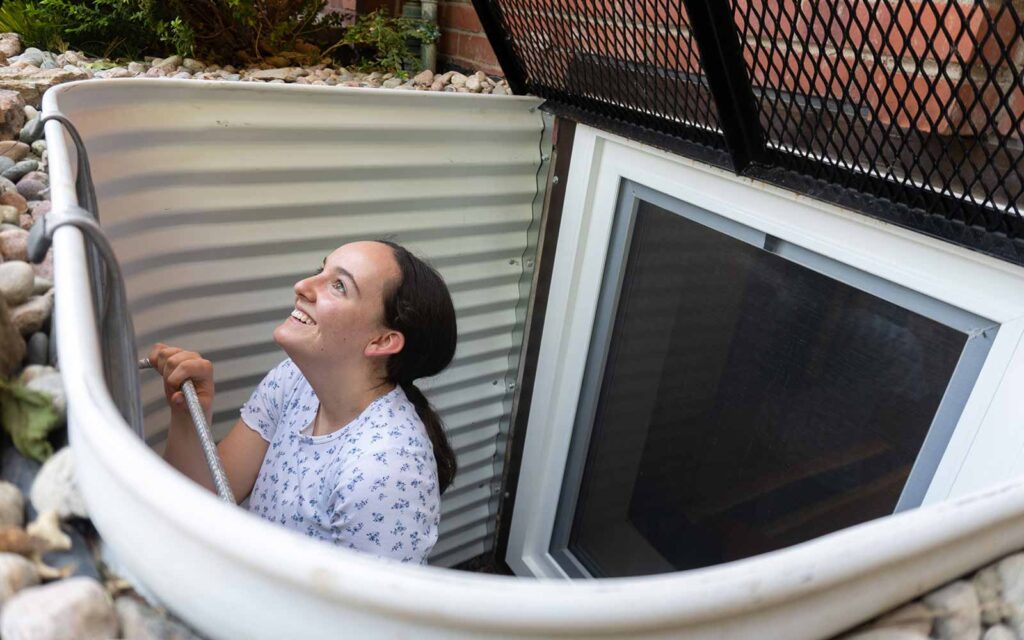
An emergency escape window for a basement is the same product Ohio code calls an egress window. It gives someone a second way out of a basement sleeping room in an emergency. Here is how the language, the code, and the project fit together.
An emergency escape window is an opening sized for a person to exit and for a rescue crew to enter. In a basement, that usually means a casement or sliding window paired with a window well outside.
The function is straightforward: the window operates without tools, the well gives the occupant room to stand and climb, and the cover (if installed) opens from below. The phrase “emergency escape window” describes the job; “egress window” is the term Ohio code uses for the same thing.
What an emergency escape window is designed to do:
Yes, in homeowner conversations they are the same product. The Ohio Administrative Code calls it an “emergency escape and rescue opening”; in the trade and on most search results, the same opening is called an egress window.
The terms you may see in research:
If you search any of those phrases for a basement bedroom, you are looking at the same code-driven project. Pick the term that feels natural; the installer translates.
An Ohio basement needs an emergency escape opening when a below-grade room is used for sleeping. Other finished living spaces — rec rooms, offices, exercise rooms — are reviewed with the local building department, but the clearest trigger is a bed in the room.
What turns a basement room into a sleeping room in code terms:
Ohio code sets minimum size and sill-height requirements for emergency escape openings — your installer should pull current specs as part of the permit. The local building department confirms the final requirements before work starts.
The window meets a minimum net opening when fully open and sits within the local sill-height range from the finished floor. Your installer pulls the current numbers from the Ohio code as part of the permit so the inspector signs off on the finished installation.
The “net clear opening” is the unobstructed space when the window is in the open position. A casement that swings open clears the opening cleanly; the installer chooses the unit style that best matches the planned opening.
What the inspector reviews on the final visit:
For the full Ohio code breakdown, use the Ohio requirements guide.
The well needs enough projection from the wall, enough clear floor area, a permanent ladder when deep enough, and a working drain at the base. The window and well are designed together as one system.
A well that meets the rule is sized as a system with the window. The window opens into the well, the well gives the occupant room to stand, and the ladder (if required) reaches from the well floor to grade.
What a working well includes:
The egress windows page covers the well in more depth.
Most older basement windows can be converted into emergency escape openings. The conversion includes cutting the foundation, setting a new lintel, building the well outside, and finishing the inside trim — the same scope as a new install.
The conversion is reviewed against the current code so the finished opening meets today’s spec.
What gets reviewed before calling it a conversion:
A fixed glass-block panel is a great daylight upgrade in a non-sleeping room; for a sleeping room, an operable egress window is the right choice. The glass block vs. egress comparison covers when to choose each one.
An emergency escape opening works best when the people who sleep in the room have practiced using it. Walking through the operation after install is part of the handoff.
A simple household practice plan:
A simple practice routine keeps everyone in the home comfortable using the emergency exit.
No. The same opening serves as an emergency exit for any situation where a second way out of the basement is needed.
A code-aware basement exit door can serve the same emergency-exit purpose. The door, its hardware, and the path to grade are reviewed and permitted as their own scope.
For a basement bedroom, an operable egress window is the right choice for emergency escape. Glass block is a great daylight upgrade in a non-sleeping room.
If a basement room may be marketed as a bedroom, adding egress before the sale gives buyers a clear answer on the bedroom plan. Ask your agent, inspector, or local reviewer how the room should be described.
A basement emergency escape opening is easier to plan when the room, the foundation, and the exterior grade are reviewed together. Evolve Egress can confirm whether your basement needs a new opening, a conversion, or a well upgrade. Start at /get-a-quote/ to request a free estimate.
Our team is ready to assist you. Call one of our offices using the phone numbers below or text us at (614) 852-4608